
Support JazzBoston with a donation or merch purchase!
JazzNOW series continues with Int’l Jazz Day concert April 30th!
Jazz Community BBQ – let us know what you think!
JazzBoston Jazz Jams continue at Oggi in Harvard Sq 2nd & 4th Thursdays
JazzBoston Hot Club Listening Sessions free and online!
13th Annual Arlington Jazz Festival April 4-7
Discount Tix for JazzBoston members!
Support JazzBoston with a donation or a merch purchase!
JazzBoston is entirely volunteer-run – we have no paid staff. We do this because we are passionate about the value and importance of this music and this community. If you’d like to support jazz in Boston, please consider including JazzBoston in your donation plans. You can donate directly at https://jazzboston.org/get-involved/donate, and you can purchase JazzBoston merch at https://www.bonfire.com/store/shop-jazz-boston. Thank you for your membership, and don’t forget to tell your jazz-loving friends that they can join for free at http://jazzboston.org!
JazzNOW series continues with an International Jazz Day concert on April 30th, featuring Cuban-born composer, pianist, and vocalist Zahili Gonzales Zamora!

On April 30th (International Jazz Day) GBH Music & JazzBoston will present JazzNOW: Afro Cuban Rhythms of Resilience, with Zahili Gonzales Zamora. It promises to be an extra-special concert. In-person attendance is ticketed. Streaming attendance is free, but pre-registration is required. For either option, visit https://www.wgbh.org/events/gbh-music-presents-jazznow-featuring-zahili-gonzalez-zamora. And on June 6th JazzNOW will present a Salute to Duke Ellington from Mark Harvey’s Aardvark Jazz Orchestra!
JazzBoston Free Jam Sessions return at a new venue in Harvard Square!
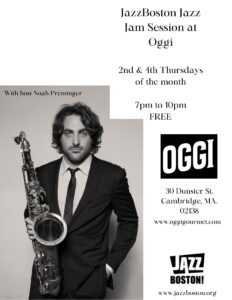
FREE, open to the public ALL-AGES jazz jams are moving to a great new venue: Oggi, 30 Dunster St, Harvard Square, Cambridge, on 2nd & 4th Thursdays from 7-10pm. We’ll kick this off on March 14th! Bring your instrument, come to play, come to hang, come to listen, come to have dinner and drinks! The house band will play a set at 7pm, and the open jam will follow.
JazzBoston Hot Club Listening Sessions free & online!
Join Bill Goldberg and his special guests for free online jazz listening sessions mostly (but not always) on first & third Wednesdays of the month at 7pm at the Zoom link: https://us06web.zoom.us/j/86215122439?pwd=ZHA5bnpWVFNFVXkxRE01K1I1aWhvZz09
Coming up:
Apr 3: Margo Cooper, photographer & author of Deep Inside the Blues
May 1: drummer & educator Grant Calvin Weston, who performed with Ornette Coleman, James Blood Ulmer, Jamaaladeen Tacuma, Marc Ribot, Dave Bryant
May 22: Saxophonist Bob Mover, who worked with Charles Mingus, Chet Baker, Jimmy Garrison, Tom Harrell
Shop JazzBoston Merch!!

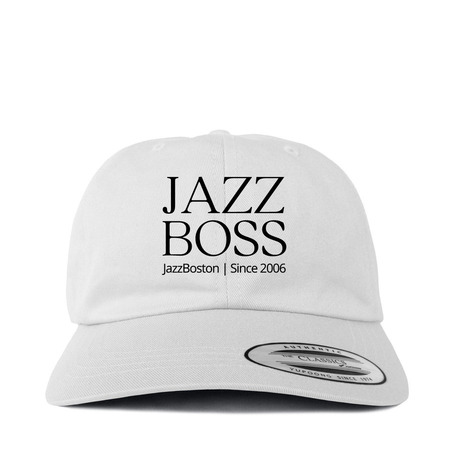

There is now a quick and easy way to buy official JazzBoston hats & t-shirts, and to support JazzBoston at the same time!! Thanks to volunteer Nate Aronow and JazzBoston Advisory Council Chair Cj Kelley, we now have an official online store hosted by the fine folks at Bonfire. Browse and shop at
https://www.bonfire.com/store/shop-jazz-boston!
JazzBoston membership is free, and open to all members of the Boston-area jazz community, including musicians, audiences, venues/presenters, and jazz media!
In an effort to encourage everyone to participate and eliminate any financial barriers, there is no charge to become a JazzBoston member. Whether you are already a subscriber or were a past member, if you’d like to continue your support of, and advocacy for, the Boston area jazz community, we strongly encourage you to sign up again for free JazzBoston membership.
https://mailchi.mp/jazzboston.org/membership-sign-up-form
Donations are still accepted in order to assist with ongoing JazzBoston expenses. You can donate at:
https://jazzboston.org/get-involved/donate/
JazzBoston Inc. is a 501(c)(3) organization. Donations to JazzBoston Inc. are tax-deductible to the full extent allowed by law.
Boston Jazz History Blog:
Buddy Rich, Phil Wilson, and “Mercy Mercy Mercy”
Boston jazz historian Richard Vacca’s Boston Jazz Chronicles is an amazing and valuable resource. We encourage jazz musicians and fans to check it out.
Vacca’s beautifully maintained and researched blog includes regular features about noted people & places that helped shape the Boston-area jazz scene. The current entry is about the the recording of the Joe Zawinul composition “Mercy, Mercy, Mercy” by the Buddy Rich Big Band in 1968, and the connections of the band and that recording to Boston, and to Boston legend Phil Wilson. You can read about it here!
Music Museum of New England:
Serge Chaloff
Child prodigy Serge Chaloff was born in Boston on November 24, 1923. He became “the most expressive and openly emotive baritone saxophonist jazz has ever witnessed,” according to critic Brian Davis in his liner notes for Chaloff’s classic LP Boston Blow-Up! Read a fascinating short biography of Serge Chaloff by D.S. Monahan in this entry on the website of the Music Museum of New England.
Our programs have been funded in part by generous grants from: